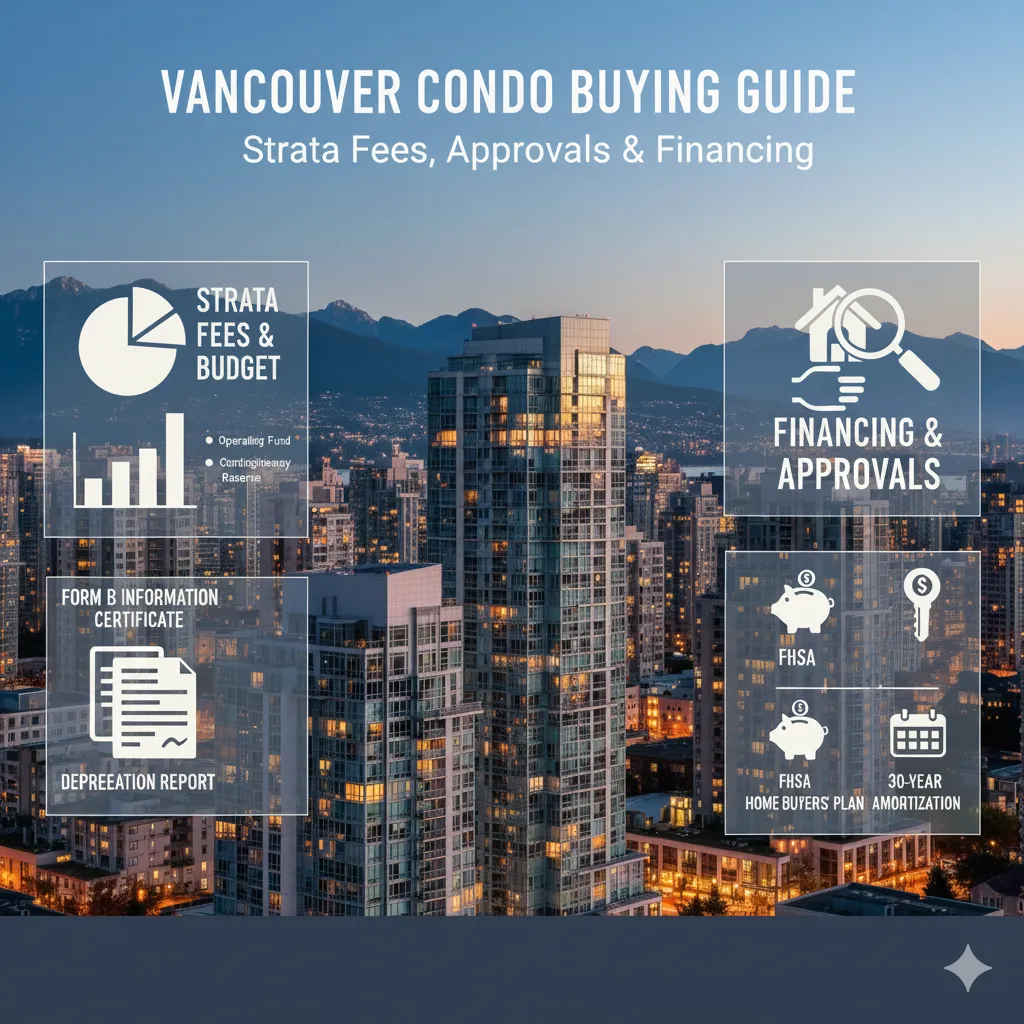
Vancouver Condo Buying Guide: Strata Fees, Approvals & Financing
Introduction
Are you considering purchasing a condo in Vancouver but feeling overwhelmed by strata fees, approval requirements, and financing complexities? You're not alone—Vancouver's condo market presents unique challenges that can catch even seasoned buyers off guard.
In Metro Vancouver, typical condo owners budget between $400 and $500 per month for strata fees alone, and recent data suggests approximately 135,000 BC condo owners will face special levies averaging nearly $7,500 per unit this year. Understanding these costs before you make an offer isn't just smart—it's essential for protecting your financial future.
This comprehensive guide breaks down everything you need to know about Vancouver condo strata fees, the critical documents that affect your mortgage approval, and financing strategies tailored for BC's unique market. By the end, you'll have the knowledge to navigate your condo purchase with confidence and avoid costly surprises.
Table of Contents
Listen to my podcast here: Vancouver Condos
Understanding Vancouver Strata Fees
Strata fees represent one of your largest ongoing costs as a condo owner in Vancouver—often rivaling property taxes in their impact on your monthly budget. Before making an offer, you need to understand exactly what you're committing to.
What Do Strata Fees Cover?
Your monthly strata fee funds two critical accounts. The operating fund handles day-to-day expenses including building maintenance, common area utilities, garbage disposal, cleaning services, landscaping, and building insurance premiums. The contingency reserve fund (CRF) accumulates money for major repairs and replacements that occur less frequently, such as roof replacement, elevator modernization, or building envelope restoration.
As of November 2023, BC strata corporations must contribute a minimum of 10% of their annual operating budget to the CRF—a regulation designed to reduce the frequency of unexpected special levies.
Current Vancouver Strata Fee Ranges
Strata fees vary significantly based on building type, age, location, and amenities. For concrete high-rise condos in Metro Vancouver, expect to pay between $0.55 and $0.70 per square foot monthly. Wood-frame low-rise buildings typically range from $0.45 to $0.55 per square foot, while townhouses generally fall between $0.25 and $0.40 per square foot.
For a typical 750-square-foot Vancouver condo, this translates to approximately $400 to $525 per month. Buildings with luxury amenities such as pools, fitness centres, and concierge services command higher fees, sometimes exceeding $0.85 per square foot.
Why Low Fees Can Be a Red Flag
A common mistake among Vancouver condo buyers is viewing low strata fees as a positive. In reality, unusually low fees often indicate deferred maintenance, inadequate reserve fund contributions, or both. Buildings that underfund maintenance inevitably face larger repair bills down the road—costs that get passed to owners through special levies.
Think of it like car maintenance: skipping oil changes saves money today but leads to engine failure tomorrow. Well-managed buildings maintain appropriate fee levels to fund ongoing maintenance and build healthy reserves.
Essential Strata Documents for Mortgage Approval
Your mortgage lender doesn't just approve you—they must also approve the building. Understanding which documents lenders scrutinize helps you identify potential financing obstacles before you're emotionally invested in a property.
The Form B Information Certificate
The Form B is arguably your most critical document when purchasing a Vancouver condo. This legally binding certificate, provided by the strata corporation upon request, discloses vital information about both the specific unit and the overall strata corporation.
Key information revealed in Form B includes: monthly strata fee amounts, any amounts owing by the current owner to the strata corporation, contingency reserve fund balance, details of any special levies (approved or proposed), information about parking stalls and storage lockers, ongoing litigation involving the strata corporation, and a summary of insurance coverage.
Lenders and mortgage insurers such as CMHC, Sagen, and Canada Guaranty carefully review Form B documentation. They're specifically looking for healthy reserve fund balances, no outstanding litigation that could affect building value, adequate insurance coverage, and no pending special levies that could strain your finances.
The Form B costs a maximum of $35 plus copying fees and must be provided within seven days of request. Always ensure you receive a current Form B—information can change quickly, and a certificate more than a few weeks old may not reflect recent developments.
Depreciation Reports: Your 30-Year Crystal Ball
A depreciation report provides a comprehensive 30-year financial forecast for the strata's common property and assets. As of July 2024, BC strata corporations with five or more lots can no longer defer obtaining these reports—they're now mandatory on a five-year cycle.
For Vancouver-area stratas without current reports, the deadline to obtain one is July 1, 2026. Starting July 2025, these reports must be prepared by designated professionals including engineers, architects, applied science technologists, accredited appraisers, certified reserve planners, or quantity surveyors.
When reviewing a depreciation report, focus on the current condition assessment of major building components (roof, windows, plumbing, elevator), projected repair and replacement timelines, estimated costs for upcoming capital projects, and the adequacy of current reserve fund contributions. A well-funded strata with a realistic depreciation report presents lower financial risk than one where major repairs loom without adequate reserves.
Strata Meeting Minutes
Two years of strata council meeting minutes reveal the building's operational reality. Look for recurring maintenance issues, owner complaints, disputes with contractors, discussions of potential special levies, and the general tone of building management.
Red flags include frequent water damage reports, ongoing structural concerns, insurance claim discussions, or contentious relationships between owners and council. These issues can affect both your quality of life and your ability to sell in the future.
Financing Your Vancouver Condo Purchase
Vancouver's high property values create unique financing considerations for condo buyers. Understanding lender requirements and available options positions you for a smoother approval process.
How Lenders Evaluate Strata Properties
Beyond your personal financial qualifications, lenders assess the building itself. Mortgage default insurers review strata documents—including meeting minutes, financials, and depreciation reports—looking for evidence that buildings have been properly maintained and that adequate reserve funds exist for upcoming projects.
Buildings with documented structural issues, ongoing litigation, minimal contingency reserves, or pending major repairs may be flagged by insurers. In some cases, insurers won't cover mortgages in specific complexes until issues are rectified, meaning only cash buyers can purchase units.
Your lender will verify that building insurance coverage meets their requirements. Since 2023, Form B must include a summary of the strata's insurance coverage, making this assessment easier. Be aware that strata insurance premiums have increased dramatically across BC in recent years, affecting both strata fees and building insurability.
Down Payment Requirements for Vancouver Condos
Canadian down payment rules apply uniformly across BC. For purchase prices up to $500,000, the minimum down payment is 5%. For homes priced between $500,000 and $1.5 million, you need 5% on the first $500,000 plus 10% on the remaining amount. Properties over $1.5 million require 20% down.
Example: For a $750,000 Vancouver condo, you'd need $25,000 (5% of $500,000) plus $25,000 (10% of $250,000), totalling $50,000 minimum down payment.
Any down payment under 20% requires mortgage default insurance through CMHC, Sagen, or Canada Guaranty. This insurance protects the lender—not you—but enables you to purchase with a smaller down payment. The premium, ranging from 0.60% to 4.50% of the mortgage amount depending on your down payment percentage, can be added to your mortgage.
The Mortgage Stress Test
All mortgage applicants must qualify at the higher of 5.25% or their contract rate plus 2%. This stress test ensures you can afford payments even if rates rise. Your housing costs (mortgage principal and interest, property taxes, heating, and 50% of condo fees) must stay below 39% of gross income (GDS ratio), while total debt payments must remain under 44% (TDS ratio).
The 50% condo fee calculation significantly impacts your qualifying amount. High strata fees reduce the mortgage you qualify for, making it essential to factor these costs into your budget from the start.
First-Time Buyer Programs & Incentives
BC and federal governments offer substantial programs to help first-time buyers enter Vancouver's competitive market.
BC First-Time Home Buyers' Program
This provincial program reduces or eliminates the Property Transfer Tax (PTT) on your first home purchase. For properties valued at $500,000 or less, you pay zero PTT. Properties between $500,000 and $835,000 receive a partial exemption worth up to $8,000 in savings. The exemption phases out completely at $860,000.
To qualify, you must have lived in BC for at least one year immediately before purchase (or filed BC taxes for two of the past six years), never have owned a principal residence anywhere in the world, and be a Canadian citizen or permanent resident.
First Home Savings Account (FHSA)
This federal program allows you to contribute up to $8,000 annually (lifetime maximum $40,000) toward your first home purchase. Contributions are tax-deductible like an RRSP, and withdrawals for home purchase are completely tax-free like a TFSA—giving you benefits on both ends.
Home Buyers' Plan (HBP)
The HBP allows first-time buyers to withdraw up to $60,000 from their RRSP tax-free for a home purchase ($120,000 for couples buying together). You must repay the withdrawn amount over 15 years, starting two years after withdrawal, to avoid having it taxed as income.
30-Year Amortization for First-Time Buyers
Recent federal changes allow first-time buyers with less than 20% down payment to access 30-year amortization periods on insured mortgages. This extends your payment timeline, reducing monthly payments and potentially helping you qualify for a larger mortgage—particularly valuable in Vancouver's high-cost market.

FAQs
How much should I budget for Vancouver condo strata fees?
For Metro Vancouver condos, budget between $0.45 and $0.70 per square foot monthly, depending on building type and amenities. A 700-square-foot unit typically costs $350 to $490 monthly in strata fees alone. Always add potential special levy contributions—experts suggest budgeting an additional $2,000 to $3,000 annually for older buildings to account for these assessments.
Can a special levy affect my mortgage approval?
Yes. Pending or proposed special levies can impact mortgage approval, particularly large assessments for major repairs. Lenders evaluate whether you can afford both your mortgage payments and levy obligations. If a building has a substantial pending levy, some lenders may require proof you have funds to cover it or may decline the application entirely. Always review strata minutes and Form B carefully for any mention of upcoming assessments.
What happens if a strata building is "flagged" by mortgage insurers?
When CMHC or other insurers flag a building due to maintenance issues, structural concerns, or financial problems, they won't provide mortgage insurance for purchases in that complex. This means buyers must either pay cash or have a 20% down payment for conventional financing. Flagged buildings typically see reduced buyer pools and lower property values until issues are resolved and the flag is removed.
How do I know if a building's contingency reserve fund is adequate?
Compare the CRF balance against the depreciation report's recommended funding levels. A healthy reserve fund should align with or exceed the depreciation report's projections for upcoming capital expenditures. As a rough guideline, look for at least $1,000 to $2,000 per unit in reserves, though older buildings with major projects approaching may need significantly more. Low reserves often predict future special levies.
Should I get a pre-approval before looking at Vancouver condos?
Absolutely. A mortgage pre-approval clarifies your maximum purchase price, locks in an interest rate for 60 to 130 days, and demonstrates to sellers that you're a serious, qualified buyer. In Vancouver's competitive market, pre-approved buyers have significant advantages when making offers. The pre-approval process takes 24 to 48 hours and requires income documentation, credit assessment, and down payment verification.
Conclusion
Purchasing a Vancouver condo involves navigating a complex landscape of strata fees, approval requirements, and financing considerations unique to BC's market. By understanding how strata fees work, knowing which documents lenders scrutinize, and leveraging available first-time buyer programs, you position yourself for a successful purchase without costly surprises.
The key takeaways: always review Form B, depreciation reports, and two years of strata minutes before removing subjects; budget for both ongoing strata fees and potential special levies; and get pre-approved to understand your true purchasing power in Vancouver's dynamic market.
Ready to take the next step toward Vancouver condo ownership? A mortgage pre-approval gives you the clarity and confidence to make competitive offers. Call Bill Karalash at 604-265-5858 or schedule a free consultation to discuss your options.
About the Author: Bill Karalash is a licensed Sub-Mortgage Broker (License #MB610235) operating under Breezeful Brokerage (License #MB601942), serving the Greater Vancouver area and all of British Columbia. Specializing in first-time buyer mortgages, pre-approvals, and refinancing, Bill provides personalized guidance to help clients navigate BC's unique real estate financing landscape.
External Citations
BC Government - Strata Depreciation Reports: https://www2.gov.bc.ca/gov/content/housing-tenancy/strata-housing/operating-a-strata/repairs-and-maintenance/depreciation-reports
BC Government - Form B Information Certificate: https://www2.gov.bc.ca/gov/content/housing-tenancy/strata-housing/renting-buying-selling/buying-and-selling-strata/paperwork-for-buyers-and-sellers/form-b-information-certificate
BC Government - First Time Home Buyers' Program: https://www2.gov.bc.ca/gov/content/taxes/property-taxes/property-transfer-tax/exemptions/first-time-home-buyers
CMHC - Mortgage Loan Insurance Requirements: https://www.cmhc-schl.gc.ca/consumers/home-buying/mortgage-loan-insurance-for-consumers/what-are-the-general-requirements-to-qualify-for-homeowner-mortgage-loan-insurance
BC Financial Services Authority - Strata Property FAQs: https://www.bcfsa.ca/industry-resources/real-estate-developer-resources/strata-property-faqs
Need help with your Vancouver condo mortgage? Call Bill Karalash at 604-265-5858 or Get Pre-Approved Today.
