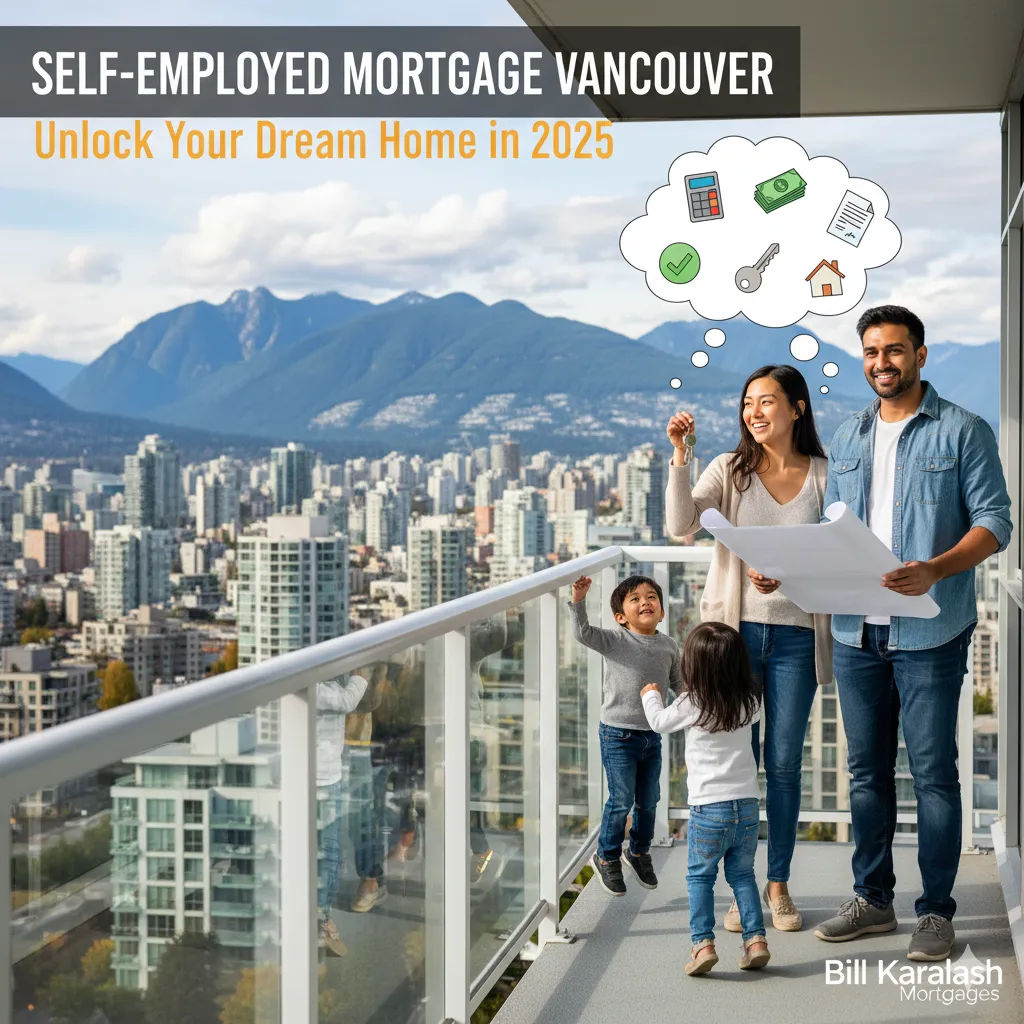
Self-Employed Mortgage Guide for Vancouver Entrepreneurs
Introduction
Are you a Vancouver entrepreneur wondering if homeownership is even possible when you work for yourself? You're not alone. With approximately 2.65 million self-employed Canadians making up nearly 15% of the workforce, getting a self-employed mortgage in Vancouver has become one of the most common financing challenges business owners face today.
Vancouver's thriving tech scene, growing startup ecosystem, and entrepreneurial spirit have created thousands of freelancers, consultants, and business owners who contribute significantly to our local economy. Yet these same professionals often face roadblocks when trying to secure mortgage financing in a city where the average home price exceeds $1.1 million.
The good news? Self-employed mortgages are absolutely achievable with the right preparation, documentation, and guidance. In this comprehensive guide, you'll learn exactly what Vancouver lenders require from self-employed borrowers, which income verification methods work best for your situation, and how to position your application for approval—even if your income fluctuates from month to month.
Table of Contents
Listen to our podcast on Self-Employed Mortgages, Vancouver Edition.
Understanding Self-Employed Mortgage Requirements in Vancouver
Securing a mortgage as a self-employed professional in Vancouver requires meeting specific criteria that differ from traditional employment scenarios. Lenders need confidence that your income is stable enough to support mortgage payments in BC's competitive real estate market.
Who Qualifies as Self-Employed?
According to Canadian mortgage lending guidelines, you're considered a self-employed borrower if you run a business alone, with a partner, or through a corporation; receive 25% or more of your income from your business; or operate as a sole proprietor, independent contractor, or incorporated professional.
Core Requirements for Self-Employed Mortgages
Most prime lenders in Vancouver require a minimum of 24 months operating your business or working in the same line of work. This allows them to calculate a multi-year income average that accounts for the natural fluctuations in business revenue. If you've been self-employed for less than two years, alternative lending options may still be available through B-lenders or CMHC's flexible self-employed program.
Credit requirements are typically stricter for self-employed applicants. Most A-lenders prefer credit scores of 680 or higher, though some B-lenders work with scores as low as 600. Your credit history demonstrates your ability to manage debt responsibly—a critical factor when income verification is more complex.
Beyond time-in-business and credit score, lenders will assess your debt-to-income ratios. The Gross Debt Service (GDS) ratio should generally stay at or below 39%, while the Total Debt Service (TDS) ratio should remain at or below 44%, though these thresholds vary by lender.
Ready to see what you qualify for? Get Pre-Approved Now and receive your personalized mortgage assessment within 24-48 hours.
Income Verification Methods for Business Owners
One of the biggest challenges self-employed borrowers face is proving their income to lenders. Unlike traditional employees who receive T4 slips showing consistent salary, business owners often have complex income structures that require more sophisticated documentation.
Traditional Income Verification
If you can prove your income through personal tax returns and Notices of Assessment (NOAs), you'll access the same mortgage products and competitive rates as traditionally employed borrowers. This method works best for self-employed professionals who pay themselves a consistent salary and don't aggressively minimize taxable income through business deductions.
For traditional verification, lenders will calculate your qualifying income by averaging your net self-employment income from your T1 General tax returns over the past two to three years. If your income has increased year-over-year, some lenders may weight more recent years more heavily in your favor.
Stated Income Programs
Many Vancouver entrepreneurs face a common dilemma: minimizing taxes means reporting lower income, which then reduces mortgage qualification amounts. Stated income mortgage programs address this challenge by using alternative documentation to verify your actual earning capacity.
Under programs like CMHC Self-Employed, Canada Guaranty's Low Doc Advantage, or Sagen's Business for Self (BFS) program, lenders can consider your business financial statements and bank statements to verify or "gross up" your declared income. These programs assess whether your stated income is reasonable based on your business type, industry norms, gross revenue, and ownership structure.
Important: Stated income programs typically require a minimum 10% down payment and may have slightly higher insurance premiums. However, they're offered at no additional cost through CMHC Self-Employed, making homeownership accessible for qualified business owners.
Alternative Income Considerations
Self-employed borrowers can also include other consistent income sources in their applications. If you receive regular child support payments, Canada Child Benefit (CCB) payments, or dividend income from investments, these can strengthen your mortgage qualification. You'll need documentation showing at least 12-24 months of consistent receipt.
Have questions about which income verification method suits your situation? Schedule a Free Consultation with Bill Karalash to review your options.
Down Payment and Insurance Requirements
Understanding down payment requirements is crucial for Vancouver entrepreneurs planning their home purchase. The amount you put down affects not only your monthly payments but also which lenders and insurance programs you can access.
Standard Down Payment Requirements
For self-employed borrowers who can fully verify their income through traditional documentation, down payment requirements are identical to regular mortgages. You'll need a minimum of 5% down on the first $500,000 of the purchase price, plus 10% on any portion between $500,000 and $1.5 million. Properties priced above $1.5 million require a minimum 20% down payment.
Mortgage Default Insurance for Self-Employed Borrowers
When your down payment is less than 20%, mortgage default insurance is required. Three providers offer this insurance in Canada: CMHC, Sagen, and Canada Guaranty. For self-employed borrowers with verified income, premiums range from 2.80% (for 15-19.99% down) to 4.00% (for 5-9.99% down) of the mortgage amount.
If you're using a stated income or Business for Self program without traditional income documentation, you'll need a minimum 10% down payment and must work with a lender using Sagen or Canada Guaranty. Premium rates for these programs are slightly higher to reflect the additional risk, but the difference is manageable for most borrowers.
What This Means for Vancouver Buyers
Given Vancouver's average home price of approximately $1.1 million, most self-employed buyers should plan for meaningful down payments. For example, purchasing a $1,100,000 home in Vancouver requires a minimum down payment of $85,000 (5% on $500K + 10% on $600K). At this level, your CMHC premium would be approximately 4% of the mortgage amount, or roughly $40,600, which is added to your mortgage and amortized over the loan term.
Many Vancouver entrepreneurs find that saving for a larger down payment—ideally 20% or more—eliminates the insurance premium entirely and expands their lender options significantly.
Documentation Checklist for Self-Employed Borrowers
Preparation is everything when applying for a self-employed mortgage. Having organized, comprehensive documentation ready before you apply can significantly speed up your approval timeline and demonstrate your financial credibility to lenders.
Essential Documents for All Self-Employed Applicants
Start gathering the following documents well before you plan to apply. Your application package should include two to three years of personal T1 General tax returns with all schedules, Notices of Assessment (NOAs) from the Canada Revenue Agency for the same years, business registration documents or articles of incorporation, and government-issued identification.
Additional Documents for Business Income Verification
Depending on your business structure and the income verification method you're using, you may also need to provide business financial statements prepared by an accountant (profit and loss statements, balance sheets), six to twelve months of business bank statements showing deposits and cash flow, a recent business license, GST/HST returns demonstrating business activity, and contracts or agreements showing ongoing client relationships.
Personal Financial Documents
Beyond business documentation, lenders will want to see proof of your down payment source (savings accounts, investment statements, or gift letters from immediate family), recent pay stubs if you pay yourself a regular salary, and statements for any debts including credit cards, lines of credit, car loans, and existing mortgages.
Pro Tips for Documentation Success
Create digital copies of everything organized in clearly labeled folders. Write brief explanations for any income fluctuations, large deposits, or business changes that might raise questions. Consider working with a professional accountant to ensure your financial statements are lender-ready. Most importantly, file your taxes on time every year—unpaid taxes or missing NOAs are red flags that can delay or derail your application.
Need help organizing your application? Book an Appointment to review your documentation with an experienced mortgage professional.
Working with A-Lenders vs. B-Lenders vs. Private Lenders
Not all lenders are created equal, and understanding your options can save you thousands over the life of your mortgage. As a self-employed borrower in Vancouver, you may have access to financing from multiple categories of lenders, each with distinct advantages and trade-offs.
A-Lenders (Major Banks and Credit Unions)
A-lenders include Canada's major banks like RBC, TD, Scotiabank, BMO, and CIBC, along with large credit unions. These lenders offer the lowest interest rates and most competitive terms, but they also have the strictest qualification requirements.
To qualify with an A-lender as a self-employed borrower, you'll typically need fully documented income through tax returns and NOAs, a credit score of 680 or higher, and the ability to pass the mortgage stress test at the qualifying rate. Some A-lenders, like RBC, offer specific self-employed mortgage products that provide flexibility on documentation while still offering competitive rates.
B-Lenders (Alternative Lenders)
B-lenders such as Equitable Bank, Home Trust, MCAP, and Merix Financial serve borrowers who don't quite fit A-lender criteria. These lenders are particularly valuable for self-employed Canadians because they often accept stated income applications with alternative documentation, offer higher debt service ratios (up to 39% GDS and 44% TDS), and work with credit scores as low as 600-650.
The trade-off is slightly higher interest rates—typically 0.5% to 1.5% above prime lender rates. However, for many self-employed borrowers, the flexibility to qualify based on actual business cash flow rather than reported taxable income makes B-lenders an excellent choice.
Private Lenders
Private lenders are individuals or mortgage investment corporations that lend their own capital. They're the most flexible option but come with significantly higher interest rates, often ranging from 7% to 18%, along with additional fees.
Private mortgages make sense for self-employed borrowers who need short-term bridge financing, are rebuilding credit while establishing a business, or need to close quickly on an investment opportunity. Most private mortgages are structured as one to two-year terms with the expectation that you'll refinance to a traditional lender once your financial profile strengthens.
The Mortgage Broker Advantage
Working with a mortgage broker gives you access to all three lender categories through a single application process. As your broker, I can match your self-employed income profile with the lender most likely to approve your application at the best available rate—saving you time and potentially thousands in interest costs.

FAQs
How long do I need to be self-employed to qualify for a mortgage in Vancouver?
Most lenders require a minimum of 24 months of self-employment history to qualify for a mortgage. This two-year requirement allows lenders to calculate an average income that accounts for business fluctuations. However, CMHC's Self-Employed program offers some flexibility for recently self-employed borrowers who have been operating for less than 24 months, particularly if you have prior experience in the same line of work. Alternative lenders and B-lenders may also consider applications with shorter self-employment histories if other factors like credit score, down payment, and cash flow are strong.
Can I qualify for a mortgage if I write off a lot of business expenses?
Yes, you can still qualify even with significant business deductions. While traditional income verification uses your net income after expenses, stated income programs and Business for Self (BFS) programs allow lenders to consider your gross business revenue and typical industry income levels. Through programs offered by Sagen and Canada Guaranty, lenders can "gross up" your declared income by analyzing your business bank statements and financial records. You'll need at least a 10% down payment for these programs, but they're specifically designed to help business owners who minimize taxable income qualify for mortgage amounts that reflect their true earning capacity.
What credit score do I need for a self-employed mortgage?
The minimum credit score varies by lender type. A-lenders (major banks) typically require a minimum credit score of 680, with some preferring 700 or higher for self-employed applicants. B-lenders often work with credit scores as low as 600-650, though you'll pay slightly higher interest rates. For mortgage default insurance through CMHC, at least one applicant must have a minimum credit score of 680. Private lenders may approve applications with lower credit scores, but interest rates increase significantly. Regardless of which lender you work with, a higher credit score improves your rate options and approval chances.
How much can I borrow as a self-employed person in Vancouver?
Your borrowing capacity depends on your documented or stated income, existing debts, credit score, and down payment. As a general guideline, lenders use debt service ratios to determine affordability—your housing costs plus other debts shouldn't exceed approximately 44% of your gross income. For a self-employed borrower with a verified income of $150,000 per year and minimal other debt, this could translate to a mortgage of approximately $600,000 to $700,000, depending on current interest rates and the property's location. A personalized pre-approval is the best way to determine your exact borrowing capacity.
Is it harder to get a mortgage when self-employed versus traditionally employed?
Self-employed mortgage applications require more documentation and preparation than traditional employment applications, but approval rates can be just as high when you work with the right lender and prepare properly. The key differences are documentation complexity (business financials versus a simple T4), income verification method (averaged income versus current salary), and lender selection (some lenders specialize in self-employed borrowers while others don't). Working with a mortgage broker who understands self-employed income structures significantly improves your chances of approval and helps you access the best rates available for your situation.
Conclusion
Securing a self-employed mortgage in Vancouver isn't about meeting impossible standards—it's about understanding what lenders need and presenting your financial story effectively. With 15% of Canadians working for themselves, lenders have developed programs specifically designed to serve entrepreneurs, freelancers, and business owners like you.
The path to homeownership as a self-employed professional starts with preparation. Get your documentation organized early, understand which income verification method works best for your business structure, and plan for a down payment that positions you for the best rates and terms. Vancouver's real estate market moves quickly, and having a pre-approval in hand gives you the confidence and credibility to act when you find the right property.
Whether you're a tech entrepreneur in Mount Pleasant, a consultant in Yaletown, or a small business owner anywhere in Greater Vancouver or BC, your business success can absolutely translate into mortgage approval. The key is working with a mortgage professional who understands self-employed income and has relationships with lenders who specialize in serving business owners.
Ready to take the next step toward homeownership? Call Bill Karalash at 604-265-5858 or schedule a free consultation to discuss your self-employed mortgage options. Let's turn your entrepreneurial success into the keys to your new Vancouver home.
About the Author
Bill Karalash is a licensed Sub-Mortgage Broker (MB610235) operating under Breezeful Brokerage (MB601942) in Vancouver, BC. Specializing in helping entrepreneurs, freelancers, and self-employed professionals secure mortgage financing, Bill provides personalized guidance throughout the Greater Vancouver area and all of British Columbia. Contact Bill for expert mortgage advice tailored to your unique situation.
External Sources Cited
Statistics Canada – Self-Employment and Business Ownership in Canada (statcan.gc.ca)
Canada Mortgage and Housing Corporation – CMHC Self-Employed Program (cmhc-schl.gc.ca)
Greater Vancouver REALTORS® – Monthly Market Report (gvrealtors.ca)
Ratehub.ca – Self-Employed Mortgage Requirements (ratehub.ca)
Business Development Bank of Canada – Canadian Entrepreneur Statistics (bdc.ca)
