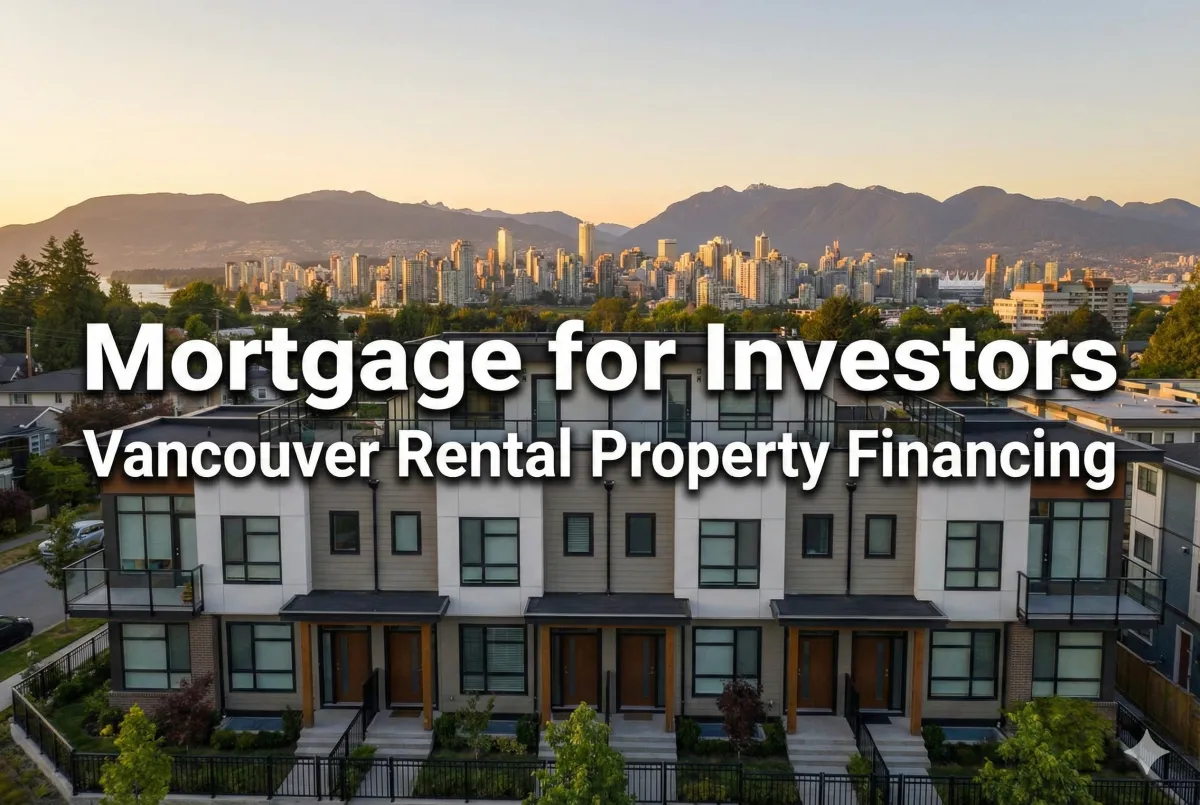
Mortgage for Investors: Vancouver Rental Property Financing
Introduction
Are you considering joining the ranks of Vancouver property investors? With Metro Vancouver's benchmark home price sitting at $1,132,500 and rental vacancy rates rising to their highest levels in 20 years, 2025 presents unique opportunities for savvy real estate investors. However, securing a mortgage for investors requires navigating different rules than purchasing your primary residence.
Understanding investment property financing is crucial before diving into Vancouver's competitive rental market. From higher down payment requirements to rental income qualification methods, the path to building your property portfolio demands specialized knowledge and strategic planning.
In this comprehensive guide, you'll discover everything needed to finance your Vancouver rental property, including current down payment requirements, how lenders evaluate rental income, BC landlord regulations you must understand, and tax advantages that can boost your returns. Whether you're eyeing a downtown condo or a multi-unit property in the suburbs, this guide provides the roadmap to your investment success.
Ready to explore your options? Book a Free Consultation or call Bill Karalash at 604-265-5858 for personalized investment property financing guidance.
Table of Contents
Investment Property Mortgage Requirements in Canada
Financing an investment property differs significantly from obtaining a mortgage for your principal residence. Understanding these requirements upfront prevents surprises and positions you for approval success.
Down Payment Requirements
For non-owner-occupied investment properties in Canada, the minimum down payment is 20% of the purchase price. This applies to properties with 1-4 units where you will not be living in any of the units. Unlike primary residences where you can put down as little as 5%, investment properties do not qualify for CMHC mortgage insurance when non-owner-occupied.
However, if you plan to live in one unit while renting the others (owner-occupied investment), your down payment options improve:
Duplex (2 units): Minimum 5% down payment on the first $500,000, plus 10% on amounts exceeding $500,000
Triplex or Fourplex (3-4 units): Minimum 10% down payment
5+ units: Requires commercial mortgage financing with 15-20% minimum down
For a $750,000 Vancouver rental property purchased as a pure investment, you would need at least $150,000 for your down payment.
Credit Score and Debt Service Ratios
Investment property mortgages require stronger qualifications than primary residence loans. Most lenders require:
Credit score: Minimum 680, though 700+ provides access to better rates
Gross Debt Service (GDS) ratio: Below 39%
Total Debt Service (TDS) ratio: Below 44%
The mortgage stress test applies to rental properties, meaning you must qualify at either your contract rate plus 2% or the benchmark rate of 5.25%, whichever is higher.
Interest Rates for Investment Properties
Investment property mortgage rates typically run 0.25% to 0.50% higher than rates for owner-occupied homes. With the Bank of Canada's policy rate currently at 2.25% and variable rates around 3.45-3.75%, investors can still access competitive financing.
Get Pre-Approved for Your Investment Property – Our streamlined process delivers answers within 24-48 hours.
Vancouver Rental Market Outlook for 2025
Understanding Metro Vancouver's rental landscape helps investors make informed decisions about property selection and expected returns.
Current Market Conditions
Vancouver's rental market is experiencing a significant shift in 2025. According to CMHC data, the vacancy rate in Metro Vancouver increased to 1.6% in 2024—the highest in 20 years (excluding the pandemic year of 2020). CMHC projects this will rise to 2.1% in 2025 and 2.9% by 2027.
For investors, this means:
More negotiating power when purchasing rental properties
Longer tenant search times may be necessary
Competitive pricing becoming essential to attract quality tenants
The average rent in Vancouver's purpose-built rental stock reached $1,967 in 2024, representing a 4.4% increase year-over-year. However, advertised rents in Q1 2025 declined 2% to 8% compared to the same period last year, signaling a cooling market.
Property Prices and Investment Opportunities
The Metro Vancouver housing market shows mixed signals for investors:
Condo apartments: Benchmark price of $728,800, down 4.4% year-over-year
Townhouses: Benchmark price of $1,069,800, down 2.7% year-over-year
Detached homes: Average price of $2.10M, up 1.6% year-over-year
Entry-level condos and townhouses present attractive entry points for first-time investors, while multi-unit properties in suburban markets like Burnaby, Surrey, and Langley offer stronger cash flow potential due to lower per-door acquisition costs.
Rental Yield Considerations
When evaluating Vancouver rental properties, consider current rental yields against your financing costs. With a benchmark condo at $728,800 and average one-bedroom rents around $2,200 monthly, gross yields hover around 3.6%. Factor in mortgage payments, strata fees, property taxes, and maintenance to determine your actual cash flow position.
How Lenders Calculate Rental Income for Qualification
One of the most misunderstood aspects of investment property financing is how lenders treat rental income when assessing your mortgage application.
Rental Income Inclusion Methods
Canadian lenders typically use 50% to 80% of rental income for qualification purposes—not 100% as many investors assume. The specific percentage depends on your lender and the property type.
Standard Approach (Most Lenders):
Use 50% of gross rental income
Add this amount to your qualifying income
Rental income offsets property carrying costs
Net Rental Income Approach (Select Lenders):
Calculate gross rent minus operating expenses
Use resulting net income for qualification
May allow higher mortgage amounts for strong properties
For properties without existing tenants, lenders will use an appraiser's estimate of market rent based on comparable properties in the area.
Documentation Requirements
To qualify using rental income, prepare the following:
Existing lease agreements for current tenants
Rental appraisal for vacant properties
T1 General tax returns showing rental income history (if applicable)
Property financials including expenses and cash flow statements
Income Ratio Limitations
Some lenders limit how much of your qualifying income can come from rental sources. If more than 50% of your application income is rental income, certain lenders may decline based on this ratio alone, viewing the application as more commercial than personal investment.
Tip: Working with an experienced mortgage broker who specializes in investment properties ensures access to lenders with the most favorable rental income policies for your situation.
Schedule Your Investment Property Consultation – Let's discuss your specific financing needs.
BC Landlord Regulations Every Investor Must Know
British Columbia's Residential Tenancy Act governs all landlord-tenant relationships. Understanding these regulations protects your investment and helps you avoid costly disputes.
Rent Increase Limits
For 2025, the maximum allowable rent increase in BC is 3%, adjusted annually for inflation. Landlords must provide three full months' written notice using the official RTB-7 form before implementing any increase. Rent can only be raised once every 12 months per tenancy.
Tenant Notice Requirements
Recent amendments to the Residential Tenancy Act have significantly changed notice requirements:
Personal use evictions: As of June 18, 2025, landlords must provide 3 months' notice plus 1 month's rent compensation. The landlord or family member must occupy the property for at least 12 months.
Sale of property (buyer moving in): 3 months' notice plus 1 month's rent compensation
For-cause evictions: 1 month's notice
All tenancy ending notices must now be submitted through the Residential Tenancy Branch's Landlord Use Web Portal to ensure compliance.
Security Deposit Rules
BC law limits security deposits to half of one month's rent. Landlords must return deposits within 15 days of tenancy end or receipt of the tenant's forwarding address, whichever is later. Pet damage deposits are separate and also capped at half a month's rent.
Key Investor Considerations
Personal occupancy evictions are prohibited in purpose-built rental buildings with 5+ units
Tenants can dispute eviction notices within 30 days
Bad-faith evictions can result in significant financial penalties
Landlords are responsible for maintaining properties to health and safety standards
For detailed guidance, consult the BC Residential Tenancy Act and the Province of British Columbia's tenancy resources.
Tax Benefits of Vancouver Rental Property Ownership
Rental property ownership offers significant tax advantages that can substantially improve your investment returns when properly utilized.
Deductible Expenses
The Canada Revenue Agency allows landlords to deduct reasonable expenses incurred to earn rental income. Common deductions include:
Mortgage interest (not principal payments)
Property taxes
Insurance premiums
Maintenance and repairs
Property management fees
Advertising for tenants
Accounting and legal fees
Utilities (if landlord-paid)
Strata fees (for condos)
Report rental income and expenses on Form T776 (Statement of Real Estate Rentals) when filing your annual tax return. The CRA's Rental Income Guide provides comprehensive guidance.
Capital Cost Allowance (CCA)
CCA allows you to depreciate the building portion of your rental property over time, reducing taxable income annually. However, use CCA strategically:
CCA cannot create or increase a rental loss
When you sell, previously claimed CCA may be "recaptured" as taxable income
Claiming CCA on a property that was ever your principal residence may affect your principal residence exemption
Consult a tax professional before claiming CCA to understand the long-term implications.
Capital Improvements vs. Repairs
The CRA distinguishes between current expenses (fully deductible in the year incurred) and capital expenses (depreciated over time):
Repairs restore something to original condition (fixing a leak, repainting) – fully deductible
Capital improvements add value or extend property life (new roof, deck addition) – claimed through CCA
Maintaining detailed records of all expenses is essential, as rental income reporting is frequently audited by the CRA.
Important 2025 Tax Considerations
Net rental income qualifies as earned income for RRSP contribution room calculations
Short-term rentals (under 90 days) must comply with municipal licensing requirements, or expense deductions will be denied
Properties sold within 12 months may be subject to flipping rules, treating gains as fully taxable business income rather than capital gains

FAQs
What is the minimum down payment for an investment property in Vancouver?
For non-owner-occupied investment properties in Canada, you need a minimum 20% down payment. This requirement applies to properties with 1-4 units where you will not live in any unit. If purchasing a $750,000 rental property, expect to provide at least $150,000 upfront. Owner-occupied multi-unit properties have lower requirements: 5% for duplexes and 10% for triplexes or fourplexes. CMHC mortgage insurance is not available for pure investment properties, which is why the higher down payment is mandatory.
Can I use rental income to qualify for an investment property mortgage?
Yes, lenders typically count 50% to 80% of gross rental income toward your mortgage qualification. This rental income adds to your personal income when calculating debt service ratios. For properties with existing tenants, provide current lease agreements as proof. For vacant properties, lenders will use an appraiser's estimate of market rent based on comparable units. However, some lenders limit applications where more than 50% of qualifying income comes from rental sources, so working with a mortgage broker experienced in investment properties is beneficial.
What are the current mortgage rates for investment properties in Vancouver?
As of late 2025, investment property mortgage rates typically run 0.25% to 0.50% higher than owner-occupied rates. With the Bank of Canada's policy rate at 2.25% and prime rate at 4.45%, variable rates for investment properties currently range from approximately 3.55% to 3.90% for well-qualified borrowers. Five-year fixed rates hover around 3.70% to 4.10% depending on the lender and your qualifications. Rates are influenced by your credit score, down payment amount, and whether the property is owner-occupied or pure investment.
Conclusion
Financing a Vancouver rental property in 2025 requires understanding the unique requirements for investment property mortgages, from the 20% minimum down payment for non-owner-occupied properties to how lenders evaluate rental income for qualification. With vacancy rates rising and property prices showing signs of softening, strategic investors have opportunities to enter the market or expand their portfolios under more favorable conditions than recent years.
Success in Vancouver rental property investment depends on thorough preparation: ensuring your finances meet lender requirements, understanding BC's landlord regulations under the Residential Tenancy Act, and maximizing tax benefits through proper expense tracking and strategic use of deductions.
The combination of falling interest rates, increased inventory, and a more balanced rental market creates a window of opportunity for well-prepared investors. However, navigating investment property financing requires expertise that goes beyond standard residential mortgages.
Ready to take the next step toward building your rental property portfolio?
Call Bill Karalash at 604-265-5858 or schedule a free consultation to discuss your investment property financing options. With personalized guidance and access to competitive rates from multiple lenders, we'll help you secure the right mortgage for your Vancouver rental property investment.
Get Pre-Approved in 24-48 Hours
External Sources Cited:
About the Author
Bill Karalash is a licensed Sub-Mortgage Broker (License #MB610235) operating under Breezeful Brokerage (License #MB601942) in British Columbia. Serving Vancouver and all of BC, Bill specializes in helping investors, self-employed professionals, newcomers to Canada, and first-time buyers navigate the mortgage process with personalized solutions and expert guidance.
Contact: 604-265-5858 | billkaralash.ca
