How Much House Can You Afford in Vancouver?
Introduction
Wondering how much house you can actually afford in Vancouver's housing market? You're not alone—it's the most common question I hear from buyers across the Lower Mainland. With the average home price in Metro Vancouver hovering around $1.13 million as of late 2025, understanding your true purchasing power is more critical than ever.
Here's the reality: the number you think you can afford and the number lenders will actually approve are often very different. Canadian mortgage regulations, including the federal stress test, directly impact your borrowing capacity—sometimes reducing it by 20% or more compared to what your monthly budget might suggest.
In this comprehensive guide, I'll walk you through exactly how Vancouver mortgage affordability works, the key ratios lenders use, and practical strategies to maximize your buying power in BC's competitive market. Whether you're eyeing a downtown Vancouver condo or a family home in Surrey, you'll leave with a clear understanding of your home buying budget.
Table of Contents
Understanding Vancouver Housing Prices in 2025
Before calculating what you can afford, let's look at what you're working with in today's market. Vancouver's real estate landscape has shifted considerably, and understanding current price points helps set realistic expectations.
Current Market Snapshot
Metro Vancouver's benchmark home price sits at approximately $1,132,500, representing a modest 3.4% decrease from the previous year. This stabilization offers some breathing room for buyers who felt priced out during peak market conditions.
Here's what different property types are averaging across Greater Vancouver:
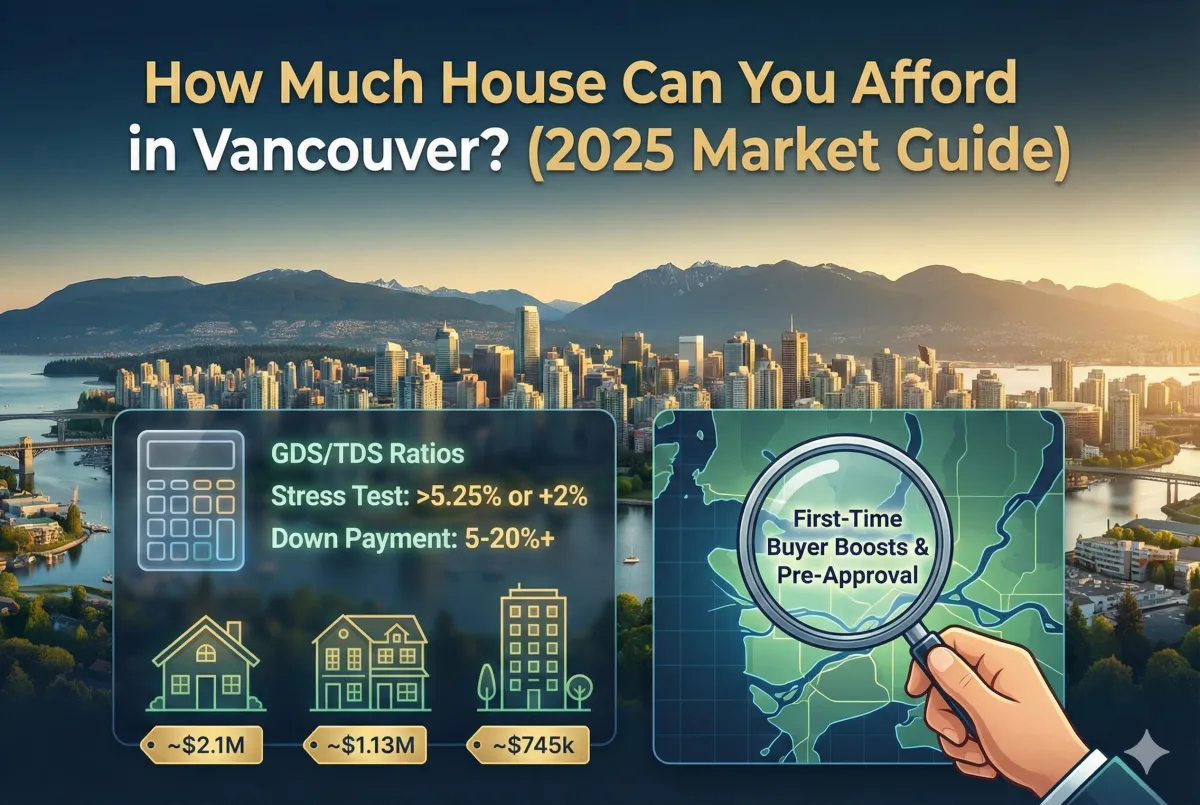
The detached home market shows average prices around $2.1 million, though benchmark prices for detached properties sit closer to $1.9 million. Townhouses and attached homes average approximately $1.07 million to $1.18 million depending on the specific area. Condominiums and apartments remain the most accessible entry point, with average prices around $730,000 to $765,000.
Regional Variations Matter
Your dollar stretches differently depending on where you're looking in the Lower Mainland. The City of Vancouver proper commands premium prices, while areas like Surrey, Langley, and Coquitlam offer more space for your budget. First-time buyers often find better value in up-and-coming neighborhoods with strong transit connections.
The good news? With the Bank of Canada's policy rate now at 2.25% (down significantly from 5% in 2023), borrowing costs have eased considerably. Combined with elevated inventory levels—over 16,000 active listings across Metro Vancouver—buyers have more negotiating power than they've had in years.
Ready to see what you qualify for? Get your personalized pre-approval in 24-48 hours.
How Lenders Calculate What You Can Afford
Understanding the math behind mortgage approvals puts you in control. Lenders don't simply look at your income—they apply specific ratios that determine your maximum borrowing capacity.
Gross Debt Service (GDS) Ratio
Your GDS ratio measures what percentage of your gross monthly income goes toward housing costs. This includes your mortgage payment (principal and interest), property taxes, heating costs, and 50% of any condo fees.
For insured mortgages (down payment under 20%), CMHC restricts your GDS to a maximum of 39%. Most lenders prefer seeing this ratio at 32-35% for optimal qualification.
The GDS formula: (Mortgage Payment + Property Taxes + Heating + 50% Condo Fees) ÷ Gross Monthly Income = GDS%
Total Debt Service (TDS) Ratio
Your TDS ratio expands on GDS by adding all your other monthly debt obligations—car payments, credit card minimums, student loans, lines of credit, and any other recurring debt payments.
The maximum TDS for insured mortgages is 44%. Keeping your TDS below 42% significantly strengthens your application.
The TDS formula: (All GDS Costs + All Other Monthly Debt Payments) ÷ Gross Monthly Income = TDS%
What This Means in Real Numbers
Let's say your household earns $150,000 annually ($12,500 monthly). Using maximum ratios, your housing costs could technically reach $4,875 monthly (39% GDS). However, if you have $800 in monthly debt payments, your total obligations are capped at $5,500 (44% TDS), meaning housing costs would be limited to $4,700.
But here's the catch—these calculations use the stress test rate, not your actual mortgage rate, which brings us to the most important factor affecting Vancouver home affordability.
The Mortgage Stress Test Explained
The mortgage stress test is the single biggest factor determining how much house you can afford in Vancouver—and most buyers don't fully understand how it works.
How the Stress Test Works
When you apply for a mortgage with any federally regulated lender, you must qualify at a rate higher than what you'll actually pay. The qualifying rate is the greater of 5.25% or your contract rate plus 2%.
For example, if you're offered a mortgage at 4.04%, you must prove you can afford payments at 6.04%. This effectively reduces your maximum borrowing capacity by approximately 20% compared to qualifying at your actual rate.
Why It Exists
OSFI (the Office of the Superintendent of Financial Institutions) implemented this requirement to ensure Canadian borrowers can handle payment increases if interest rates rise. After the dramatic rate hikes of 2022-2023, this protection proved valuable for many homeowners.
Strategies to Maximize Your Qualification
Several approaches can help you qualify for more mortgage under stress test rules.
Reducing existing debt directly improves your TDS ratio. Paying off a $400 monthly car payment could add $80,000 or more to your mortgage qualification. A larger down payment means a smaller mortgage amount, making it easier to pass the stress test at the qualifying rate. Some provincially regulated credit unions and alternative lenders aren't bound by the same stress test rules, potentially offering more flexibility for well-qualified borrowers.
Adding a co-borrower with income and manageable debt immediately expands your qualification capacity. First-time buyers often partner with parents or siblings for their initial purchase.
Want to know your exact pre-approval amount? Schedule a free consultation and I'll run the numbers for your specific situation.
Down Payment Requirements in BC
Your down payment directly impacts both what you can afford and your ongoing costs. Understanding the minimum requirements—and the benefits of putting more down—helps you make strategic decisions.
Minimum Down Payment Rules (As of December 2024)
Canada's down payment requirements follow a tiered structure. For homes priced up to $500,000, you need a minimum of 5% down. For the portion between $500,001 and $1.5 million, you need 10% on that additional amount. Homes priced above $1.5 million require a minimum 20% down payment.
Example for an $800,000 Vancouver condo: You'd need 5% of the first $500,000 ($25,000) plus 10% of the remaining $300,000 ($30,000) = $55,000 minimum down payment (6.875% of purchase price).
Mortgage Default Insurance
If your down payment is less than 20%, you're required to purchase mortgage default insurance through CMHC, Sagen, or Canada Guaranty. This insurance premium ranges from 2.8% to 4% of your mortgage amount and is typically added to your mortgage principal.
While this adds to your costs, insured mortgages often qualify for lower interest rates—sometimes 0.10% to 0.25% lower than conventional mortgages—which can offset some of the insurance cost over time.
Extended Amortization Benefits
Recent changes allow first-time home buyers and purchasers of newly built homes to access 30-year amortization periods on insured mortgages. This reduces monthly payments significantly compared to the standard 25-year amortization, improving affordability for many Vancouver buyers.
First-Time Home Buyer Programs That Boost Affordability
British Columbia and the federal government offer several programs specifically designed to help first-time buyers afford homes in expensive markets like Vancouver.
BC First-Time Home Buyers' Property Transfer Tax Exemption
This provincial program eliminates or reduces the property transfer tax on your first home purchase. You receive a full exemption on the first $500,000 of your home's value, with homes up to $835,000 receiving the maximum benefit of $8,000 in PTT savings. Partial exemptions apply for properties between $835,000 and $860,000.
To qualify, you must have lived in BC for at least 12 consecutive months, never owned a principal residence anywhere in the world, and intend to occupy the property as your primary residence.
First Home Savings Account (FHSA)
The FHSA allows you to contribute up to $8,000 annually (with a $40,000 lifetime maximum) toward your first home purchase. Contributions are tax-deductible like an RRSP, and withdrawals for a qualifying home purchase are completely tax-free—combining the best features of both RRSPs and TFSAs.
RRSP Home Buyers' Plan
First-time buyers can withdraw up to $60,000 from their RRSPs tax-free for a home purchase (up to $120,000 for couples). The withdrawn amount must be repaid over 15 years, but this effectively gives you interest-free access to retirement savings for your down payment.
Home Buyers' Tax Credit
This federal non-refundable tax credit provides up to $1,500 back at tax time for qualifying first-time home purchases, helping offset closing costs and moving expenses.
BC Home Owner Grant
Once you own your home, this annual property tax credit provides $570 to $770 in relief depending on your location within BC, reducing your ongoing ownership costs.
As your Vancouver mortgage broker, I help clients maximize every available program. Book a consultation to ensure you're not leaving money on the table.

FAQs
How much income do I need to buy a house in Vancouver?
For a $750,000 condo with 10% down ($675,000 mortgage), you'd typically need a household income of approximately $140,000 to $160,000 annually, depending on your other debts and the current stress test rate. A $1.1 million townhouse with the same down payment percentage would require roughly $200,000+ in household income. Your specific qualification depends on your complete financial picture, including existing debts, credit score, and employment type. Getting pre-approved provides exact numbers for your situation.
Can I afford a house in Vancouver on a $100,000 salary?
On a single $100,000 income with minimal debt and a 10% down payment, you could potentially qualify for a mortgage around $400,000 to $450,000 under current stress test rules. This would allow you to purchase a home in the $445,000 to $500,000 range. While this limits options in Vancouver proper, there are condos and townhouses in Surrey, Langley, and other Lower Mainland communities within this price range. Dual-income households or those with larger down payments can access significantly more.
What credit score do I need to buy a home in Vancouver?
The minimum credit score for an insured mortgage in Canada is 600, though scores above 680 typically unlock better rates and more favorable debt ratio allowances. A score of 720+ positions you for the most competitive mortgage rates available. If your credit needs improvement, even a few months of strategic credit management can boost your score significantly before applying for your pre-approval.
How do Vancouver closing costs affect affordability?
Beyond your down payment, budget 1.5% to 4% of the purchase price for closing costs. On a $750,000 property, this means $11,250 to $30,000 for legal fees, property transfer tax (unless exempt as a first-time buyer), title insurance, home inspection, and moving expenses. First-time buyer exemptions can eliminate most or all of the property transfer tax, which represents the largest closing cost for many purchases.
Conclusion
Knowing how much house you can afford in Vancouver comes down to understanding four key factors: your debt service ratios, the stress test qualification rate, your available down payment, and the first-time buyer programs you're eligible for. With average Vancouver home prices around $1.13 million but condos accessible in the $700,000 range, there are options at various price points across the Lower Mainland.
The current market conditions—stable prices, elevated inventory, and the Bank of Canada's policy rate at 2.25%—create favorable conditions for prepared buyers. Whether you're targeting a downtown condo, a Burnaby townhouse, or a Surrey detached home, understanding your true purchasing power before you start house hunting saves time and positions you to act quickly when the right property appears.
The most accurate way to know exactly what you can afford? Get pre-approved. In 24-48 hours, I'll provide your maximum mortgage amount, locked-in rate options, and a clear picture of your monthly payments—giving you the confidence to house hunt knowing exactly where you stand.
Need help with your Vancouver mortgage? Call Bill Karalash at 604-265-5858 or schedule a free consultation.
Author Bio
Bill Karalash is a licensed Sub-Mortgage Broker in British Columbia (License #MB610235) operating under Breezeful Brokerage (License #MB601942). Serving Vancouver and all of BC, Bill specializes in helping first-time buyers, self-employed professionals, and newcomers to Canada navigate the mortgage process with personalized guidance and 24-48 hour pre-approvals. Contact Bill for expert mortgage advice.
External Sources Cited
Greater Vancouver REALTORS® Market Statistics – Monthly market reports and benchmark pricing data
Bank of Canada Policy Rate Announcements – Current interest rate decisions and monetary policy
CMHC Mortgage Insurance Guidelines – Official debt service ratio requirements and insurance rules
OSFI Minimum Qualifying Rate – Stress test floor rate and Guideline B-20 requirements
BC Government First Time Home Buyers' Program – Property transfer tax exemption eligibility and thresholds
