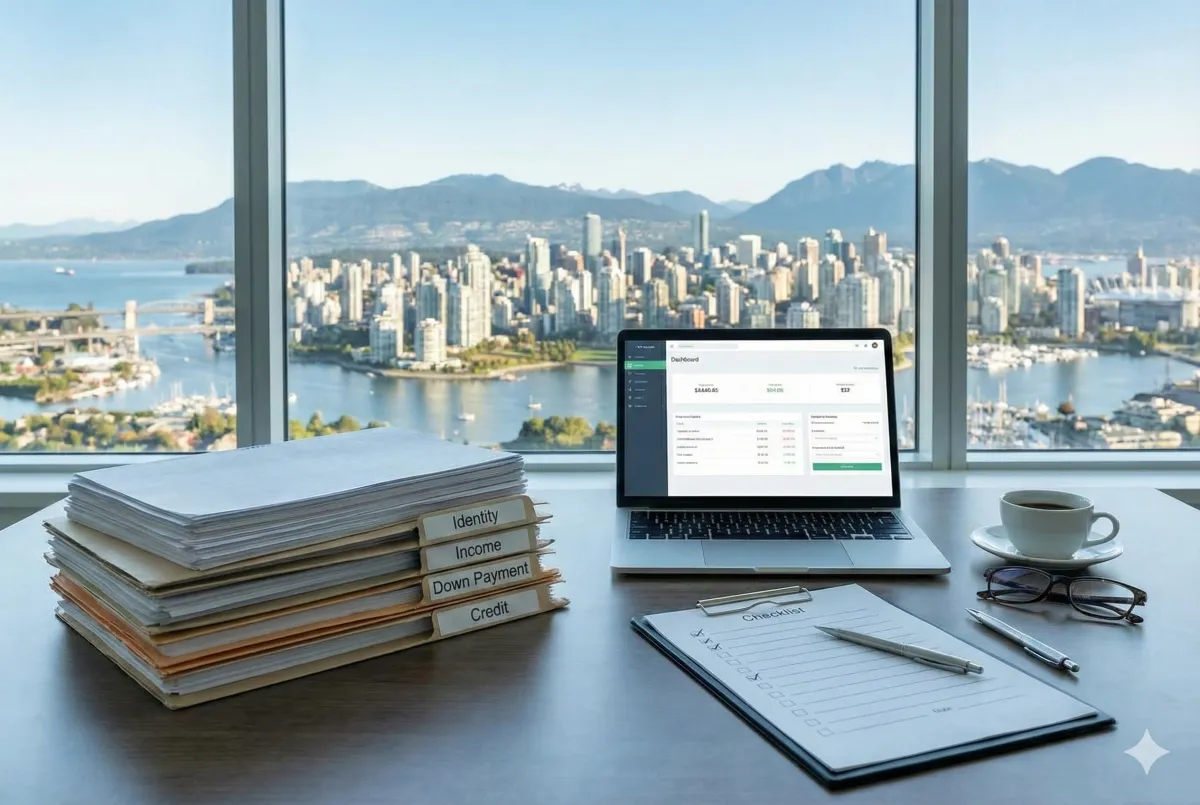
Document Checklist for Vancouver Mortgage Applications
Introduction
Are you ready to buy a home in Vancouver but unsure which documents you'll need for your mortgage application? You're not alone—gathering the right paperwork is one of the most common roadblocks that delays pre-approval for BC homebuyers.
In Vancouver's competitive real estate market, having your documentation organized before you apply can mean the difference between securing your dream home and watching it slip away to a better-prepared buyer. Lenders and mortgage insurers like CMHC require specific proof of your income, employment, identity, and financial stability before they'll approve your financing.
This comprehensive checklist covers every document you'll need for a successful Vancouver mortgage application in 2025—whether you're a salaried employee, self-employed professional, or first-time homebuyer. You'll learn exactly what lenders want to see, how to gather these documents efficiently, and common mistakes that could delay your approval.
Listen to our Podcast - Ultimate Mortgage Checklist - VancouverUtimate Mortgage Checklist - VancouverUltimate Mortgage Checklist - Vancouver
Table of Contents
Listen to the podcast about the Ultimate Vancouver Mortgage Pre-approval Checklist.
Identity and Personal Documentation
Every Vancouver mortgage application begins with verifying who you are. Since October 2024, mortgage brokers in British Columbia must comply with FINTRAC (Financial Transactions and Reports Analysis Centre of Canada) regulations, which mandate strict identity verification protocols to prevent money laundering and fraud.
Government-Issued Photo ID
You'll need to provide at least two pieces of valid, government-issued identification. Acceptable documents include your Canadian passport, BC driver's licence, BC Services Card with photo, Permanent Resident Card, or Canadian citizenship card. At least one ID must include your photograph.
Proof of Residency
Lenders need to confirm your current address and residential history. Prepare the following: your current address with at least two previous addresses if you've moved within the past three years, a utility bill or bank statement dated within the last 90 days showing your name and address, and if you're renting, a letter from your landlord confirming your rental payment history can strengthen your application.
Social Insurance Number
Your SIN is required for credit bureau inquiries. Both Equifax and TransUnion Canada use this information to pull your credit report and score, which lenders use to assess your creditworthiness. According to the Government of Canada, your credit score ranges from 300 to 900, with scores of 680 or higher typically required for conventional mortgages from major lenders.
Marital Status Documentation
If applicable, provide your marriage certificate or separation agreement. This affects how lenders calculate your debt obligations and who appears on the property title.
Ready to start your pre-approval? Get Pre-Approved Today or call Bill Karalash at 604-265-5858.
Income and Employment Verification
Demonstrating stable, verifiable income is the foundation of mortgage approval. Lenders want assurance you can comfortably make your monthly payments—and they'll scrutinize your employment situation carefully.
For Salaried Employees
The standard documentation package for employed applicants includes your most recent pay stubs covering the last 30 days showing year-to-date earnings, a signed letter of employment on company letterhead dated within 30 days stating your position, salary, employment start date, and employment status (full-time, part-time, or contract), and your T4 slips for the past two years confirming your annual employment income.
According to CMHC guidance, lenders typically look for a two-year employment history in the same role or industry to demonstrate income stability. If you've recently changed jobs but remained in the same field, this generally won't negatively impact your application.
Notice of Assessment (NOA)
Your Notice of Assessment from the Canada Revenue Agency is perhaps the most important income document. As the CRA confirms, the NOA summarizes your total income, tax deductions, credits claimed, and any balance owing or refund received. Lenders require NOAs for the past two years to verify your declared income matches what you've reported to the government.
You can access your NOAs through your CRA My Account online, or request copies by calling the CRA at 1-800-959-8281. Keep in mind that if you owe back taxes, this appears on your NOA and may affect your approval—lenders view unpaid taxes as a significant red flag.
Additional Income Sources
If you receive income beyond your base salary, you'll need documentation for commission income showing a two-year history with your T4s and employment letter specifying your commission structure, bonus income with documentation of consistent bonus payments over two years, rental income with signed lease agreements, T1 general tax returns, and proof of rental deposits, overtime pay with a letter from your employer confirming regular overtime availability.
Down Payment and Asset Documentation
Lenders must verify that your down payment comes from legitimate, acceptable sources. CMHC and other mortgage insurers have strict requirements about where your funds originate.
Bank Statements
Provide 90 days of bank statements for all accounts you'll use for your down payment and closing costs. These statements must show your name and account number, the financial institution's name and logo, all transactions and running balances, and no large unexplained deposits.
Large deposits outside your regular income pattern will require explanation. Be prepared to provide a paper trail for any deposits over $1,000 that aren't from your paycheque.
Acceptable Down Payment Sources
According to current CMHC rules, traditional down payment sources include personal savings accumulated over time, RRSP withdrawals under the Home Buyers' Plan (up to $60,000 per person as of 2024), proceeds from the sale of another property, non-repayable gifts from immediate family members, and First Home Savings Account (FHSA) withdrawals.
Gift Letter Requirements
If any portion of your down payment is a gift, you'll need a signed gift letter from the donor stating the exact gift amount, the donor's relationship to you, confirmation the funds are a true gift with no expectation of repayment, and the donor's contact information. Additionally, provide bank statements showing the funds in the donor's account and the transfer to your account.
Investment and RRSP Statements
If you're withdrawing from investments or using the Home Buyers' Plan, provide your most recent RRSP or FHSA statements, proof of available contribution room from your NOA, and confirmation of withdrawal or transfer.
Questions about your down payment options? Schedule a Free Consultation with Bill Karalash today.
Credit and Debt Information
Your credit profile tells lenders how you've managed borrowed money in the past. Understanding what they're looking for helps you prepare—and potentially improve your position before applying.
Credit Score Requirements
Canada's two main credit bureaus, Equifax and TransUnion, both generate credit scores that lenders use to evaluate your application. According to credit industry standards, conventional mortgages from major banks typically require a credit score of 680 or higher for the best rates and terms, CMHC-insured mortgages may accept scores as low as 600 with compensating factors, and alternative lenders may work with scores starting at 620 but at higher interest rates.
Before applying for a mortgage, obtain your free credit reports from both Equifax and TransUnion to check for errors or accounts you don't recognize. Checking your own credit doesn't affect your score.
Debt Documentation
Lenders calculate your debt service ratios to determine affordability. Your Gross Debt Service (GDS) ratio, representing housing costs as a percentage of income, should not exceed 39%, while your Total Debt Service (TDS) ratio, covering all debt payments as a percentage of income, should stay below 44%.
Prepare documentation for all existing debts: credit card statements showing current balances and minimum payments, car loan or lease agreements, student loan statements, personal loan or line of credit statements, and any existing mortgage statements if you own other property.
Bankruptcy or Consumer Proposal History
If you've experienced bankruptcy or a consumer proposal, you'll need discharge papers, proof of two years of re-established credit, and an explanation letter detailing the circumstances.
Self-Employed Documentation Requirements
Self-employed Vancouverites face additional scrutiny because income can be harder to verify. Nearly 20% of Canadian income earners are self-employed, yet many struggle with mortgage approval due to documentation challenges.
Business Documentation
Self-employed applicants must provide their business licence and registration, Articles of Incorporation (if incorporated), and proof the business has operated for at least two years. Most lenders require a minimum two-year self-employment history to qualify for traditional mortgage products.
Income Verification for Self-Employed
Your income documentation package should include personal tax returns (T1 General) for the past two to three years, Notices of Assessment for the same period, financial statements including income statements, balance sheets, and cash flow projections, and business bank statements for the past 12 months.
According to industry guidelines, lenders typically average your income over two years. If you've written off significant expenses to minimize taxes, your declared income may be lower than your actual cash flow—which can limit your borrowing power.
Stated Income Programs
If your declared income doesn't reflect your true earning capacity, stated income mortgage programs through insurers like Sagen or Canada Guaranty may be an option. These programs require a minimum 10% down payment, strong credit history (typically 680+), income that's reasonable for your profession, and additional documentation like bank statements and invoices.
Self-employed and ready to buy? Book Your Pre-Approval Consultation to explore your options.
First-Time Homebuyer Additional Documents
First-time buyers in BC have access to valuable programs that can save thousands of dollars—but you'll need specific documentation to qualify.
BC First-Time Home Buyers' Program
To claim the Property Transfer Tax exemption (worth up to $8,000 on homes up to $835,000), you must provide proof you've lived in BC for at least 12 consecutive months before the purchase date, or filed at least two income tax returns as a BC resident in the last six years, a statutory declaration that you've never owned a principal residence anywhere in the world, and confirmation you've never previously received the first-time home buyers' exemption.
Home Buyers' Plan (HBP) Documentation
If withdrawing from your RRSP under the HBP, prepare your RRSP contribution room statement from your most recent NOA, a completed Form T1036 from your RRSP provider, and proof you meet the first-time buyer definition.
First Home Savings Account (FHSA)
For FHSA withdrawals, you'll need your FHSA account statements, confirmation of contribution room, and proof of qualifying home purchase.

FAQs
How long does mortgage pre-approval take in Vancouver?
With complete documentation, most Vancouver mortgage pre-approvals are processed within 24 to 48 hours. However, missing or incomplete documents can extend this timeline significantly. Gathering all required paperwork before your application is the best way to ensure fast approval and rate protection for 60 to 130 days while you search for your home.
What credit score do I need for a mortgage in BC?
For conventional mortgages with major lenders, aim for a credit score of 680 or higher. CMHC-insured mortgages may accept scores as low as 600, though this may limit your lender options. Scores below 600 typically require alternative or private lenders, which come with higher interest rates. Check your credit with both Equifax and TransUnion before applying, as scores can vary between bureaus.
Can I get a mortgage without two years of employment history?
Traditional lenders prefer two years in the same role or industry, but exceptions exist. Recent graduates with job offers, professionals who changed employers but stayed in the same field, and those with strong compensating factors like excellent credit or larger down payments may still qualify. CMHC also offers programs for borrowers with less than two years of self-employment history if they can demonstrate income through contracts and bank statements.
What documents do newcomers to Canada need for a mortgage?
Newcomers require their work permit or permanent residency documentation, proof of at least three months of Canadian employment, international credit history or reference letter from their home country's financial institution, and a minimum 5% down payment (potentially higher depending on residency status). Some lenders accept foreign credit reports from the US, UK, and South Africa, while applicants from other countries may need alternative verification methods.
How do I prove my down payment is legitimate?
Provide 90 days of bank statements showing the accumulation of funds, documentation for any deposits over $1,000 that aren't regular income, gift letters with donor bank statements for gifted funds, and sale agreements and deposit receipts for proceeds from property sales. FINTRAC compliance requires mortgage brokers to verify the source of all funds, so maintain a clear paper trail.
Conclusion
Preparing the right documents for your Vancouver mortgage application doesn't have to be overwhelming. By organizing your identification, income verification, down payment proof, and credit information before you apply, you'll position yourself for faster approval and stronger negotiating power in BC's competitive housing market.
Remember the essentials: two pieces of government ID, your last two years of NOAs and T4s, 90 days of bank statements, and proof of your down payment source. Self-employed applicants should add business documentation and financial statements, while first-time buyers need residency proof for BC tax exemptions.
The most successful mortgage applications come from prepared borrowers who understand what lenders need to see. With your documentation ready, you can move quickly when you find your perfect Vancouver home—and that speed often makes all the difference in a competitive offer situation.
Need help with your Vancouver mortgage? Call Bill Karalash at 604-265-5858 or schedule a free consultation to get started on your pre-approval today.
About the Author
Bill Karalash is a licensed Sub-Mortgage Broker (License #MB610235) operating under Breezeful Brokerage (License #MB601942) in Vancouver, BC. Serving the Greater Vancouver area and all of British Columbia, Bill specializes in pre-approvals, refinancing, renewals, HELOCs, and private mortgages. With personalized service and access to multiple lenders, Bill helps Vancouver homebuyers navigate the mortgage process with confidence.
Ready to take the next step? Get Your Free Pre-Approval | Call: 604-265-5858
External Sources Cited
Canada Revenue Agency – Notice of Assessment Information: https://www.canada.ca/en/revenue-agency/services/tax/individuals/topics/about-your-tax-return/a-copy-your-notice-assessment-reassessment.html
Government of Canada – Credit Report and Score Basics: https://www.canada.ca/en/financial-consumer-agency/services/credit-reports-score/credit-report-score-basics.html
Province of British Columbia – First Time Home Buyers' Program: https://www2.gov.bc.ca/gov/content/taxes/property-taxes/property-transfer-tax/exemptions/first-time-home-buyers
FINTRAC – Obligations and Guidance for Mortgage Sector: https://fintrac-canafe.canada.ca/guidance-directives/guidance-directives-eng
CMHC – Mortgage Application Tips: https://www.cmhc-schl.gc.ca/professionals/industry-innovation-and-leadership/industry-expertise/resources-for-mortgage-professionals/mortgage-application-tips-what-your-mortgage-professional-needs-to-know
